
Art Stories: Behind the Score
Art Music: Behind every marking on the score is an idea that is felt, a creative challenge overcome, a human that refused to let go of an ephemeral moment in their mind. To engage in the transference of thought to sound is to allow experiences that can only be felt to be expressed through music, to communication sensorially, to embed in current mindset, and assist the evolution of culture.
The Score as an Object of Memory
There is something remarkable about a handwritten score. Every correction, every annotation, every smudge of ink carries the trace of a mind at work. Unlike a digital file, a physical score accumulates history. It bears the marks of its making. When a score is also a work of visual art — as with our ArtScores — this accumulation of meaning becomes even richer.
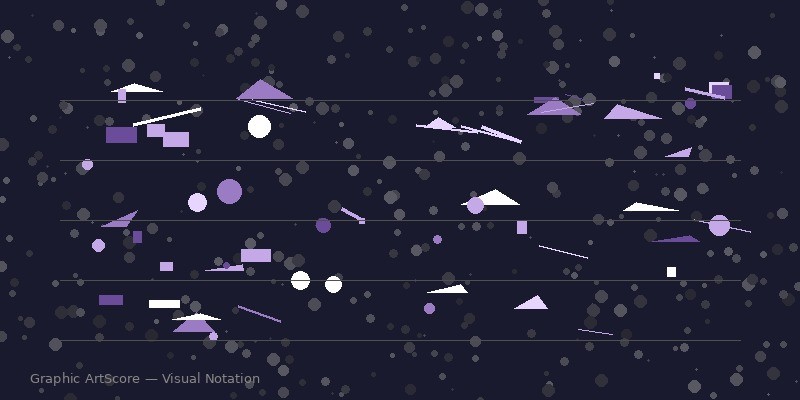
Consider a hand-painted graphic score. The brushstrokes that constitute the notation were made by a human hand in a specific moment, with a specific intention. The colour choices, the density of marks, the spaces left empty — all of these carry meaning that goes beyond the purely functional. When a performer reads such a score, they are entering into a conversation not just with the music, but with the act of its creation.
Graphic Notation and the Invitation to Interpret
One of the most distinctive features of graphic and alternative notation is the interpretive freedom it offers. A conventionally notated score specifies pitch, rhythm, dynamics, and articulation with a high degree of precision. A graphic score may specify these elements loosely, or not at all — instead offering shapes, textures, densities, and spatial relationships that performers must translate into sound.
This is not a lack of instruction. It is an invitation. The composer is saying: here is the world I have imagined. Now bring your own imagination to it. The score becomes a starting point for a collaborative creative act between composer and performer, and no two performances of the same graphic score will ever be identical.
Open Form and the Living Score
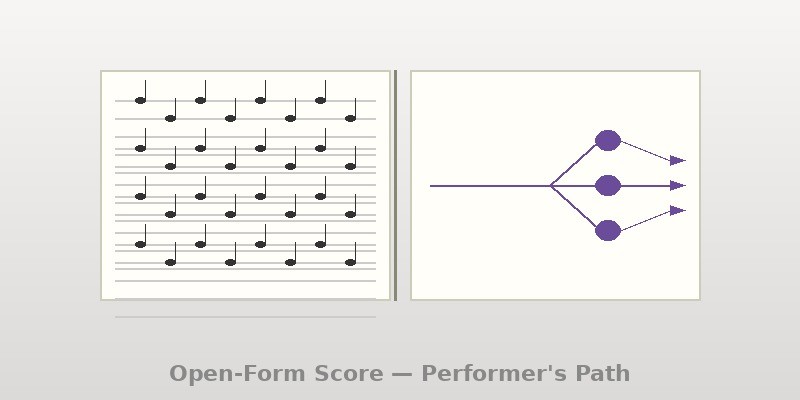
Some ArtScores incorporate open-form notation, in which the sequence of sections or events is not fixed. Performers may choose their own path through the score, guided by visual cues, improvisation frameworks, or agreed conventions. In this way, the score becomes a living document — one that generates new works with each performance.
This approach has deep roots in the experimental music tradition, from the work of John Cage and Earle Brown to the graphic scores of Sylvano Bussotti and Anestis Logothetis. Australian composers working in this tradition bring their own cultural and aesthetic perspectives to these established forms, creating works that are both globally connected and distinctly local.
Stories from Our Represented Composers
The composers represented by ArtScore Publishing each bring a unique story to their work. Some have trained in conservatoires and universities; others are largely self-taught. Some work primarily in concert music; others move freely between performance, installation, and visual art practice. What unites them is a commitment to the expressive power of notation — a belief that how music is written down matters as much as what is written.
In future editions of Art Stories, we will be sharing conversations with these composers — exploring the ideas and experiences behind specific works, and offering insights into their creative practice. We hope these stories will deepen your engagement with the scores in our collection, and remind you that behind every work of music is a human being with something urgent to say.
An Invitation
If you are a performer who has worked with one of our scores, we would love to hear your story. What did you find in the notation? What surprised you? What did the score ask of you that you did not expect? Music is made in the encounter between a score and a performer, and we believe those encounters deserve to be remembered and shared.
Browse our collection, commission a new work, or simply get in touch. We are here because we believe in the power of music to move, surprise, and connect us — and we are always glad to hear from those who share that belief.
