
The Buffering Zone
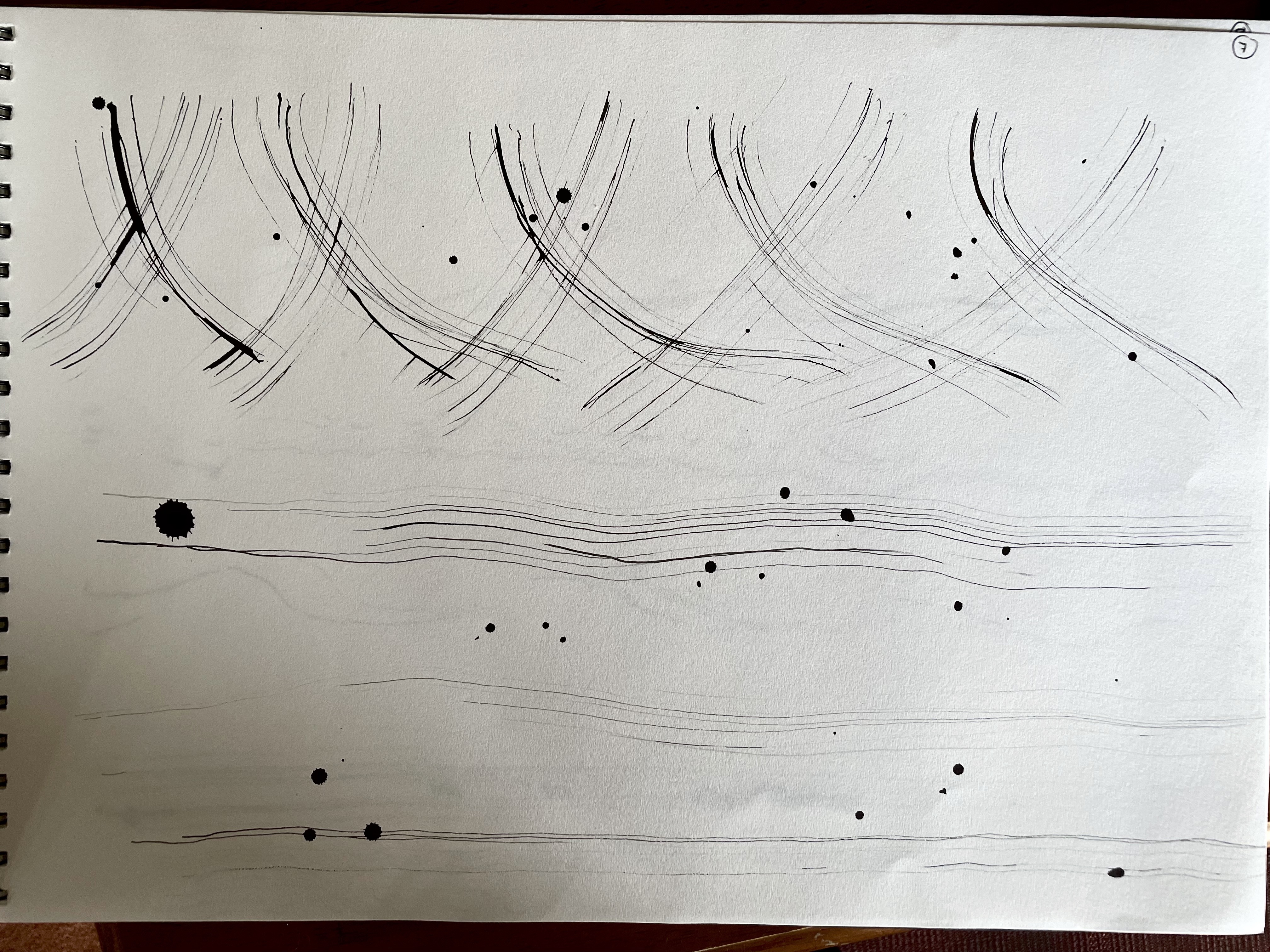
Traditional notation is an accurate method of communication between a composer and a performer however, as far as compositional processes go, where the score functions as a personal journal for the composer before it becomes an instruction manual to be handed to the performer, using traditional notation to write down initial ideas, particularly if they are complex, can be interruptive of flow as it requires many detailed decisions to be made during the initial writing process. Graphic notation can be a fast way of outlining contours, textures, structures, gestures, forces, or otherwise heard but as yet not fully realised complexities of musical ideas. Melodic shape, rhythmic impulses, temporal distributions, and interactions between voices or registers can be rapidly expressed before determining specific details, similar to producing an oil painting, like sketching onto the canvas before detailing the artwork with intricate layers of paint.
The graphic notation sketching process can facilitate an easy flow of musical ideas onto a page, like shorthand is to dictation. It can liberate the decision making process where complex rhythmic or pitch resolution is required by buffering the psychological fixedness of notation. Once an idea is notated, it can feel ‘fixed’ and difficult to shift because, once heard, it is hard to un-hear it to hear it as something else. In fine art, once the paint is on the canvas, we acknowledge it’s harder to change the work to something else, not just due to realistic practicality, but because the vision is formed. However, if an artist sees an idea they have produced that isn’t to their desire, this can be helpful to their process because they can see what they don’t want, and this aids the conceptualisation of an image they prefer. In music, its different. Once a musical idea is formed in our mind, it can be hard to alter because the idea itself is a set of pre-made decisive aspects; the pitch and rhythmic deciding factors are already formed, and once we hear them, they are difficult to un-hear. This is why composers have so many strategies for idea development. Alleviating conceptual limitation of a fixed idea is an inherent challenge in working with thoughts that arrive fundamentally preconceived.
If you’ll walk with me for a moment, we can think of musical ideas like packet cakes, as opposed to cakes made from scratch. We may decide at the outset if we want wheat or almond flour in our cake; it’s not just about flavour, it’s the foundation of what the cake is. We can liken this in music to a deciding between a tonal melody versus spectralism (please don’t get stuck on the comparisons in this analogy, they are not central to the point and I don’t know anything about cake). What I’m labouring to say here is that musical ideas arrive in our minds already formed, the ingredients are present in the idea; the pitch, the rhythms, the tonality or mode… these fundamental details define what the idea is. This is like the Muses handing us a packet cake "Here human, this idea works just fine". The ingredients of each prepackaged idea is inherently different and once made, hard to unmake because the ingredients are already combined. In order to alter an initial idea, we have to deconstruct it first before we can rethink it into being something else.
Graphic notation, when incorporated into traditional notation processes, can keep the work in the pre-stages before it hits the mixing bowl, so to speak. An extra note here, more repetitions there, this A changes to an E… and so on. For composers, we can treat graphic sketching as buffering zone where we can entertain decisions without fully fixing the ideas.
Blame science for my thoughts this morning because quantum theory validates the ‘I don’t know yet’ phase as critical to the exploration of infinite possibility. The challenge for composers is that, to remain in this phase is to keep a musical idea flexible as it arrives before decisions are made to fix it down into something more permanent, yet this involves harbouring alternatives to an idea while it is still in the inception phase. Our ingredients are not sitting in a pantry, neatly packaged, waiting for our minds to be made about whether we want gluten free or allergy tests, yet, composers may want this kind of flexibility in our musical conception. To exercise free will and have processes that support conceptual dexterity is to our benefit. This is why I believe that audiation is our best tool for manipulating material in the imagination and why graphic notation sketching of our ideas helps us float our decisions above the page before they are fixed down, while preserving a record of the ideas in visual form before they are lost in memory or overwritten by a temporary test idea.
Basically, graphic notation sketching can be incorporated into our process to remind us of what we initially heard while allowing for compositional flexibility.
Have a beautiful day.
