Programme note:
Ec(h)o is a response to environmental degradation and a sonic depiction of human influence on the planet both geologically and ideologically. The title of the composition is a quasi play-on-words with the main ideas underpinning the work. The “eco” part of the title explores the fact that ecology and economy are only a few words different, but are often in direct conflict with one another. The exponential growth that is key to many Western economies often relies on methods that are highly detrimental to ecological systems (the mining and exporting of fossil fuels, for instance). The “echo” part of the title comes from my interest in the Anthropocene, the geological age marked by human activity having the dominant influence on climate and the environment. What traces, or echoes, have humans left in various parts of nature over the last century? Present-day and historical events define the two larger movements of the work (movements II and IV), which draw upon environmental and economic data to influence musical structure; however, recurring gestures and musical materials link all five movements together, exploring echo as a metaphor.
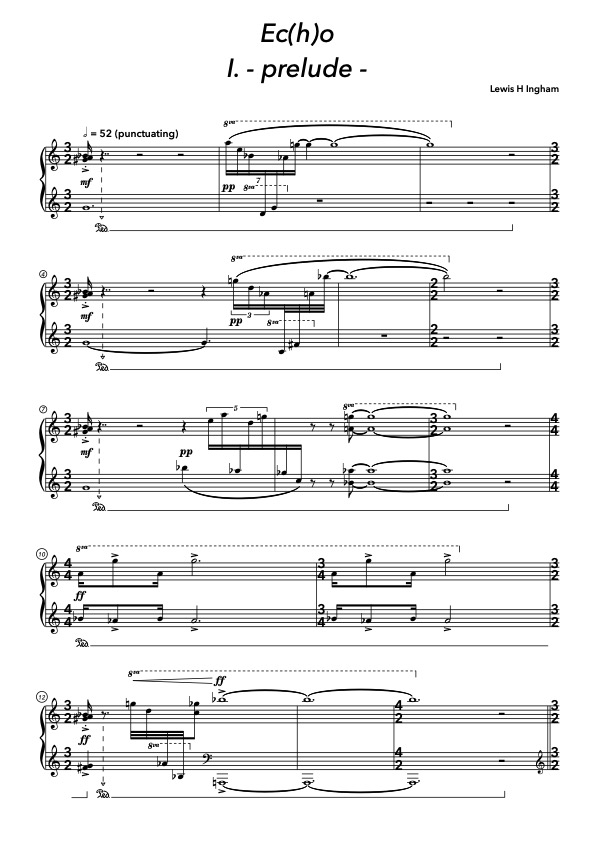
I. - prelude - pg. 1
The opening gesture to the prelude is critical to the entire composition. This gesture seeks to capture the resonance of the piano as an echo, which is then expanded and developed introducing harmonic and melodic ideas that underpin later movements.
II. - anthropocene marked - pg. 7
The first larger movement of Ec(h)o is divided into 21 individual episodes. Each episode responds to one of the following themes:
- “echo”, which is explored through a harmonic gesture that is developed throughout the movement;
- “economy”, which takes a simple theme and seeks to reinvent it over and over across the movement through a theme-and-variations model (like a product being marketed, re-marketed, advertised, re-advertised...);
- “ecology vs. economy”, which is a musical depiction of pieces of coal falling into increasing larger piles.
The duration and range of the piano used for each episode is dictated by two datasets: Australia’s coal exports over the last two decades, and Australia’s mean temperature anomaly over the same period. Both show an upwards trend, resulting in the final few episodes of the movement being notably longer and utilising a larger range of the piano.
III. - epoch beginning - pg. 17
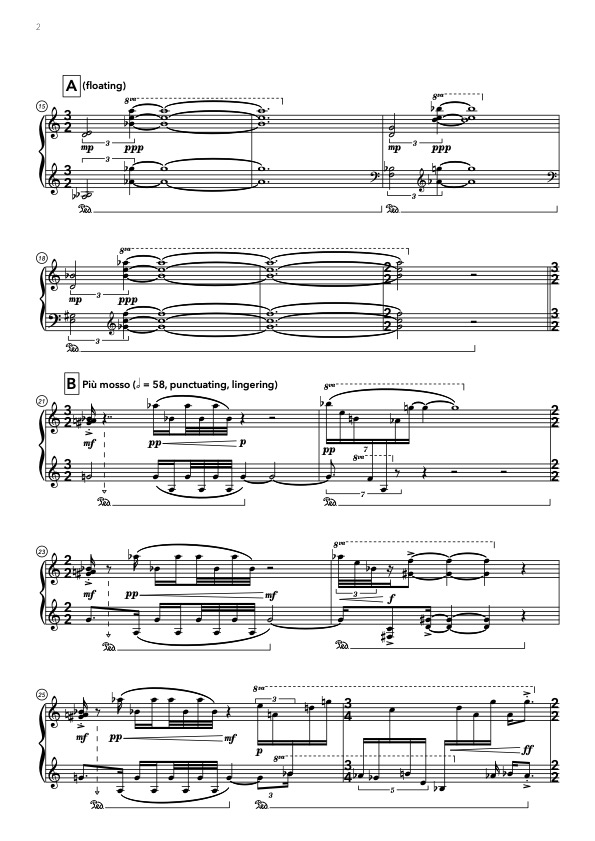
The initial echo gesture from the prelude is restated, but quickly turns into intense and fiery ascending gestures, representing atmospheric nuclear detonations that occurred during the 1940s, events that left traceable amounts of radiocarbons in tree rings, which enable us to mark to the onset of the Anthropocene.
IV. - epoch marker - pg. 21
The second of the larger movements of Ec(h)o, this movement starts with a short prelude-like introduction before moving into a slow and spacious section. This section is the first of a series of repeating cycles that unfurl across the movement. The cycles are inspired by tree cores taken from a lonely Sitka spruce on an island south of New Zealand. In these tree cores, increasing traces of radiocarbon were found, markers of atmospheric nuclear detonations from the 1940s onwards. Even in this tree on a remote island in the Southern Hemisphere, traces of human activities can still be seen. The cycles across this movement gradually increase in tempo proportionally to the amount of radiocarbon detected in the tree cores up until 1965. As the cycles progress, depicting the onset of the Anthropocene, the timbral quality of the piano begins to shift, moving from resonant and spacious gestures to dry and rapid ideas.
V. - postlude - pg. 41
The postlude provides a final restatement of the echo gesture seen in movements I and III, but finishes with a recapitulation/development of the ending gestures of movement IV.